


Concerns over payment sovereignty are bubbling up in the U.K., where a group of banks is drawing attention to an effort to build a local payment network.
Processing Content
Barclays will reportedly lead a meeting later this week, according to The Guardian, which reports U.K. financial industry executives may fund the effort that will include bank-issued cards. The concern is the dominance of Visa and Mastercard, which control 95% of the U.K. non-cash payments market (which is 86% of the total value of all U.K. payments, according to the country’s payment regulator, which also said the U.S. networks don’t have “effective competition.”
The existing initiative is designed to provide an alternative to Visa and Mastercard, though both card networks are involved in the discussions. Barclays and Visa did not provide comment by deadline, and Mastercard’s public relations office said: “The meeting this week is part of the longstanding and orderly process that was kick-started with the publication of the Government’s National Payments Vision in 2024.”
Mastercard also said, “The payment industry has never been more competitive, providing consumers and businesses with a wide range of ways to pay and get paid. Mastercard has been investing in the U.K. for decades, helping to drive commerce locally and across the globe. This commitment has not changed as we are fully focused on helping businesses of all sizes develop and grow.”
President Donald Trump’s influence on geopolitics is not the stated reason for this week’s meeting, but the American president is an elephant in the room as media outlets, including the Guardian, reported the U.K. project is borne out of President Trump’s policies and their potential threat to international payments, including recent threats to annex Greenland.
“Around the time that the West imposed sanctions on Russia over the invasion of Ukraine, I expressed worries that weaponizing payments systems would motivate countries to create their own, and this seems to be happening,” Aaron McPherson, principal at AFM Consulting, told American Banker.
Mastercard stressed the meeting this week is part of the longstanding and orderly process that was kick-started with the publication of the Government’s National Payments Vision in 2024.
“Both the meeting itself and its timing sit squarely within this longstanding and orderly program. Any suggestion to the contrary is simply incorrect,” the company said in a statement.
It’s not unusual for countries to attempt to hinder Visa and Mastercard. India, which is home to Rupay, has issued strict regulations and the U.S. card networks have long faced hurdles in China, where UnionPay is dominant.
“As to the prospects of national or pan-European payments champions, the biggest change has been the political climate,” Eric Grover, a principal at Intrepid Ventures, told American Banker. “President Trump’s barrage of tariffs and threats against friend and foe alike has put wind in the sails of calls for strategic payments autonomy from U.S.-domiciled players like Mastercard, Visa, Apple Pay, PayPal, and Google.” Mastercard and Visa — apparently to keep a place at the table — are going to invest in the U.K. banks’ effort to build another domestic payment scheme, according to Grover.
The U.K. is a surprising market for such a move, McPherson said, noting that a pay by bank model using the country’s Faster Payment network would not require the construction of a new card network just in case “the U.S. goes off the deep end.”
Other efforts to build an alternative to Visa and Mastercard in the region have not gone far. The bank-backed European Payments Initiative pushed for adoption during the COVID-19 pandemic and acquired payments fintech iDeal in 2023 to gain scale.
“[EPI] faces extraordinarily long odds of displacing Mastercard and Visa absent European regulators putting their thumb on the scale,” Grover said.
There are a number of challenges that need to be overcome for an alternative to Visa or Mastercard, according to Aaron Press, research Director of Worldwide Payment Strategies at IDC. “The most difficult is simply inertia,” IDC’s Press told American Banker, adding the U.S. networks have nearly complete penetration at issuing banks and near universal acceptance at merchants.
“Even if an alternative becomes available, getting both a critical mass of issuers and merchants on board is a herculean task,” Press said. “Even migrating existing card portfolios would take years.” —John Adams
Francesca Volpi/Bloomberg
Winter Olympics boost spending in Northern Italy
The Olympics are often associated with an economic boom from the influx of travelers visiting the host country, and this year’s winter games were no different, according to data from Visa that analyzed spending patterns on its network.
“Over the Milano Cortina 2026 Winter Olympics Opening Ceremony weekend, Italian businesses experienced a year-on-year rise in visitors and purchases, according to VisaNet data — demonstrating the positive economic impact that major global events can deliver for local communities,” Antony Cahill, CEO of Visa Europe, said in a statement.
International Visa cardholders spent more than in the previous year, with U.S. cardholders posting a 125% increase in spending, followed by Canada and Switzerland. That increase in spending was driven in part by a 160% jump in the number of U.S. cardholders visiting.
Broadly, overseas cardholder visits increased by more than 60%, led by the U.S., China, Brazil, Canada and Japan. Within Europe, Germany logged a 31% increase in visitors, followed by Switzerland, France and the UK.
German travelers were the top spenders, with an average spend of 297 euro ($350), followed by China at 257 euro ($302.96) , and the U.S. at 255 euro ($300.60). —Joey Pizzolato

DBS Bank, Westpac test agentic payments
Banks abroad are testing out agentic payments with Visa and Mastercard as the budding technology marches ahead.
DBS Bank in Singapore has been testing agentic payments using DBS credit and debit cards on Visa’s Visa Intelligent Commerce Protocol, beginning with food and beverage transactions. The pair will explore online shopping and travel bookings next, according to Visa.
“AI agents are unlocking a new phase in digital payments, where routine transactions can be completed efficiently and reliably, helping customers save time and simplify everyday tasks,” said Ananya Sen, DBS’s group head of regional consumer products, in a statement. “Our collaboration with Visa shows how agent-led payments can be deployed securely and safely at scale, giving customers confidence in how transactions are made in an AI environment.”
Separately, Westpac in New Zealand has also been testing agentic payments with Mastercard. Its proof-of-concept transaction included using a Westpac-issued debit card to purchase movie tickets from Event Cinemas. The bank followed that transaction with another that booked hotel accommodations on QT Hotels & Resorts in Queenstown.
“We’re investing heavily in innovative technology and processes to make banking faster, safer and easier for New Zealanders,” Westpac NZ managing director of product, sustainability and marketing Sarah Hearn said in a statement. “Agentic AI has huge potential to improve payment experiences, and we’re pleased to be working with Mastercard to bring the technology to our customers in the future.” —Joey Pizzolato

CHANDAN KHANNA/Photographer: Chandan Khana/AFP/
Chime scores Major League Soccer endorsement
Chime is the official debit card, credit card and retail banking sponsor of Major League Soccer, marking the fintech’s first foray into the burgeoning sport.
“Soccer is at a defining moment in the U.S. with global attention converging here this year, making it the ideal time to partner with Major League Soccer,” said Vineet Mehra, Chime’s chief growth officer, in a statement.
“This partnership reflects how Chime is evolving its approach to sports by showing up where passion runs deep and building meaningful connections through the moments that matter most, from the pitch to communities and beyond matchday,” Mehra said. “As a company serving millions of Americans, we are investing in a sport that brings communities together and resonates with the people we serve.”
The multi-year partnership brings new levels of visibility to Chime through all-star game jersey branding, integration into MLS platforms, live events, fan experiences and digital and social channels, and national advertising, among others. The 2026 MLS season starts February 21, and includes 15 matches.
Chime is the latest fintech to advertise in Major League Soccer. Early Warning Service’s Paze signed a multi-year partnership with NYC FC to be the franchise’s official digital wallet and online checkout provider and a founding franchise partner of the club’s forthcoming stadium, Etihad Park, beginning in 2026. —Joey Pizzolato

Philip Pacheco/Bloomberg
Visa adds to its stablecoin network
Quantoz has signed an agreement with Visa to enable the Netherlands-based fintech to act as a BIN [Bank Identification Number] sponsor, or a classification that will enable Quantoz to facilitate virtual Visa card issuance and support stablecoin payments across Visa’s merchant network.
Quantoz and Visa will focus on Europe, where the firms aim to convince third party platforms to embed Visa card issuance directly into their products, with flexibility for branding, pricing and card controls.
“Becoming a Visa principal member is a major milestone for Quantoz. It allows us to make regulated digital money truly usable in day-to-day payments, while removing the complexity for fintechs and platforms,” Arnoud Star Busmann, CEO of Quantoz Payments, said in a release.
“By handling the regulatory, operational and technical heavy lifting, we enable our partners to launch branded card products that connect compliant digital money with one of the world’s most widely accepted payment networks.”
For Visa, it’s a boost of the card network’s stablecoin strategy, which includes consulting, settlement and real-time payments. —John Adams
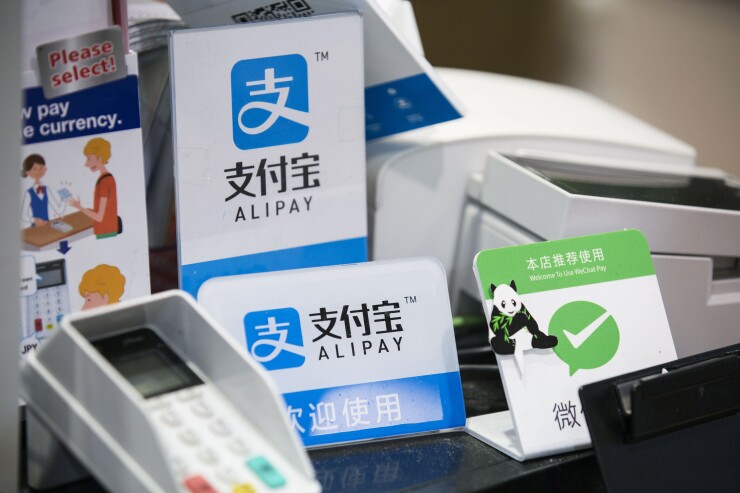
Alipay’s agentic payment tool gains traction in China
Consumers in China are warming up to agentic payments, evidenced by a surge in Alipay’s agentic payment tool.
Called AI Pay, the agentic payment tool logged more than 120 million transactions for the week ended Feb. 9, the super app provider said.
Alipay’s AI Pay, which was launched in 2025, allows AI agents to make autonomous payments on behalf of consumers, and runs inside apps and mini programs. In September of last year, Singaporean coffee retailer Luckin Coffee tested the technology, incorporating voice authentication into the payment process by allowing consumers to say, “place order” to initiate payment.
That pilot was followed by a December collaboration with smart glasses manufacturer and software developer Rokkid that allows developers to access AI payments with natural language rather than complex coding. And in January, Alipay launched its own Agentic Commerce Trust Protocol, including Alibaba’s Qwen App that also allows the app’s AI to place food and beverage orders within the app. —Joey Pizzolato
Payoneer adds Stripe tech to accommodate stablecoins
Cross-border payments fintech Payoneer plans to develop stablecoin technology that will be embedded in its platform.Payoneer will access tools from Bridge, a stablecoin infrastructure company that Stripe acquired in 2025. Payoneer will offer business clients the ability to receive, hold and send stablecoins.
Firms can receive payments in stablecoin, or use stablecoins to pay suppliers or contractors. Funds can be held in stablecoins or withdrawn to a local bank account.The new tools will begin rollout in the second quarter.
“No-friction money movement is essential for global business,” said John Caplan, CEO of Payoneer, in a release. —John Adams

UnionPay boosts ATM access in the UK
NCR Atleos has added cash access to UnionPay cardholders, covering a potential market of 13,000 ATMs located in high-traffic and tourist areas in the U.K.
The two firms will push deployment as a way to reach more travelers or local residents from China by enabling an easier way to pay.
“Reliable cash access is essential for UnionPay cardholders when traveling to the UK—especially for transactions where cash remains preferred,” said James Yang, executive vice president of the European Region, UnionPay International, in a release.
As cash usage fades, NCR Atleos has entered a series of partnerships to boost its network since the split of NCR in 2022. NCR Atleos is focused on ATMs, while NCR Voyix sells digital commerce technology. —John Adams
